
Types of Tow Trucks: Regular, Hydraulic, Wheel-Lift and Enclosed
Regular flatbed, hydraulic, wheel-lift or enclosed? We explain the types of tow trucks in plain language, when each one suits your car, when it can harm it, and how to choose the right one before you call.
Last updated: October 2026 · By the Satha Alam team
- Open 24/7
- 10+ years in KSA
- 19K+ vehicles towed
Regular flatbed, hydraulic or winch: why the type of tow truck matters
When people call for a tow, most never ask what kind of truck is coming and assume all tow trucks are the same. In reality the difference between a regular flatbed, a hydraulic flatbed and a wheel-lift is big, and it directly affects your car’s safety, especially if it is low, four-wheel drive, electric or not running.
This article covers the types of tow trucks you will hear about in Jeddah: the regular flatbed, the hydraulic flatbed, the flatbed with a winch, the wheel-lift, the enclosed carrier and the large heavy-duty truck. Each has jobs it suits and limits you should know before handing over your car.
To be upfront: Satha Alam works with a hydraulic flatbed fitted with a pulling winch, plus straps and chains on four points. We do not have an enclosed truck or a wheel-lift, and we will tell you honestly when you need those and when our flatbed is enough.
This matters in Jeddah in particular, where one street holds family sedans, 4x4s for desert trips, low sports cars, a growing number of EVs and small school and company buses, alongside basement car parks in towers, narrow old streets and sandy edges. Choosing the right type beats simply calling the nearest truck.
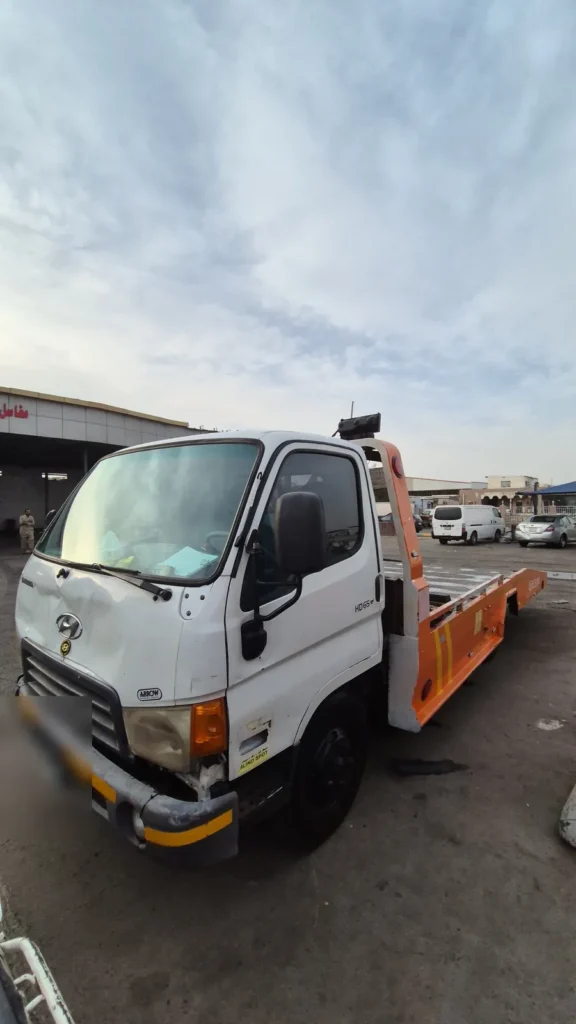
The regular flatbed: when it is enough and when it is not
A regular flatbed is a truck with a fixed, level bed. The car goes up on steel ramps placed at the back, or is pulled up if there is a winch. The bed does not tilt, so the loading angle is fairly steep because the bed sits high.
It works fine in many cases: a normal-height car that runs and is parked in open space. The driver drives it up the ramps, straps it and goes. Transport itself is safe because the whole car is on the bed.
Problems start with low and sports cars, where the steep ramp angle can scrape the front bumper or underbody on the edge of the bed. A car that does not run, without a winch, has to be pushed up, which is hard and risky. So a regular flatbed is useful, but not for everything.
How do you know if a regular flatbed is coming? Ask directly: does the bed tilt, and is there a winch? If your car is low, say so before the truck sets off so the driver can plan the right method instead of discovering the problem at your car.
The hydraulic flatbed: a bed that tilts down close to the ground
A hydraulic flatbed uses rams to lift the front of the bed and tilt it back, and on many trucks the bed also slides back until its end nearly touches the ground. The result is a much gentler loading angle than ramps, so the car rolls up without scraping.
That matters for low, luxury and sports cars, and for electric and hybrid cars that should not be towed on their wheels. The car travels fully on the bed, with no tyre wear and no strain on the gearbox or drivetrain.
Once the car is up, the bed returns level and the car is secured with straps or chains at four points so it does not shift over bumps or sudden braking. This is the type Satha Alam uses, and we consider it the safest choice for most small and mid-size vehicles in the city.
These are the loading steps we follow with every car:
1. Park on firm ground
We pick level, solid ground near the car and switch on hazard lights if we are on a road.
2. Tilt the bed
We slide and tilt the bed until its end is near the ground, adjusting the angle to the car’s height.
3. Load the car
A running car drives up slowly; a dead one is winched up under control, centred on the bed.
4. Secure four points
The bed goes level and the car is strapped or chained at four points, then tension is checked.
5. Final check
We confirm the gear position and handbrake and that nothing is loose, then set off.
Flatbed tow truck with winch: when the car will not start
People use the word winch in two ways. The common meaning in Jeddah is a flatbed with a winch: a cable at the front of the bed that pulls a non-running car up onto it. Some people use winch for any tow truck, including the wheel-lift.
A winch is essential for a flat battery, a failed engine, a car that cannot move after an accident, or one sunk in sand or with wheels in a roadside ditch. Without it, loading these cars is difficult and risky.
The winch works slowly and under control while the driver keeps the car centred on the bed. So when you order a tow for a dead car, check that the truck coming actually has a winch, not just ramps. Ours does, so we can load dead or damaged cars safely and pull a stuck car a short way to where it can be loaded.
Car stuck? Let us pick it up now
Call us or send your location on WhatsApp. We will tell you the price and arrival time in minutes. The Satha Alam team is ready day and night.
The wheel-lift: lifts one end, drags the other
A wheel-lift tow truck has a steel arm at the back that goes under two of your wheels, front or rear, and lifts them. The car travels hanging from one end while the other end rolls on its tyres the whole way.
It is quick to hook up and compact enough for tight spots. The downside is obvious: half the car is on the road. Four-wheel-drive cars, electric cars and some automatics can be damaged when dragged any distance, and a crushed front end or damaged tyre makes lifting difficult or unsafe.
Satha Alam does not have a wheel-lift. Our alternative is the hydraulic flatbed that carries the whole car, so none of its wheels touch the road and you do not have to worry about the gearbox or drivetrain.
The enclosed carrier: full protection from sun and dust
An enclosed carrier is a truck or trailer with a fully closed box, so the car travels away from sun, dust, rain and onlookers. It is mainly used for rare classics, very high-end cars, show cars and long trips where a car would face hours of dust.
For a short trip inside the city, most people do not need one. A properly strapped car on a hydraulic flatbed travels safely, and exposure on a Jeddah trip is limited. If your car is a rare piece with very delicate paint, an enclosed carrier is worth considering.
We do not have an enclosed truck. For luxury and low cars in Jeddah we offer a hydraulic flatbed with a gentle loading angle, correct tie-down points and smooth driving. If your car truly needs enclosed transport, look for a specialist.
A tip for owners of luxury cars, whatever the truck: photograph the car from every side before loading and point out sensitive spots like large rims, a low bumper, fresh paint or sensors. It protects both sides.
The large tow truck for heavy loads
A large or heavy-duty tow truck is built for big trucks, full-size buses and heavy equipment like loaders and excavators. Its bed is longer and wider, its engine stronger and its capacity far higher.
Our hydraulic flatbed handles light to medium loads up to about 3.5 tons: sedans, SUVs, pickups, vans, small buses like the Coaster and Rosa, light Dyna trucks, generators, workshop machines, light equipment such as a Bobcat or small forklift, and motorcycles and quad bikes.
Anything heavier, like a loaded truck or heavy machinery, needs a specialised large truck, and we advise against putting it on an undersized one. If you are unsure of the weight, send us the type, model and a photo and we will tell you honestly whether we can move it.
Types of tow trucks compared in one table
This table sums up the differences so you can quickly see what fits your situation and what we actually offer.
| Type | Loading method | Suits | Does not suit | At Satha Alam |
|---|---|---|---|---|
| Regular flatbed | Ramps onto a fixed, high bed | Normal cars that run, in open space | Low cars, and dead cars without a winch | We use hydraulic instead |
| Hydraulic flatbed | Bed tilts with its end near the ground | Most cars, including low, luxury and electric | Heavy loads beyond its capacity | Available |
| Flatbed with winch | Winch pulls the car onto the bed | Dead, damaged and stuck cars | Useful in almost every case | Our flatbed has a winch |
| Wheel-lift | Lifts one end, drags the other | Short trips, cars that tolerate towing | 4×4, electric and damaged cars | Not available |
| Enclosed carrier | Fully closed box | Rare and classic cars, long trips | Usually not needed for short city trips | Not available |
| Large tow truck | Long bed, high capacity | Big trucks, buses, heavy equipment | Tight spaces and small cars | We carry up to about 3.5 tons |
Which type of tow truck suits your car?
You do not need to memorise every type. Ask three questions: what is the car, does it run, and where is it parked. Then use this list:
If you are unsure, photograph the car from the side and close to the front bumper and send it. From that we can see the ground clearance, tyres and front end and tell you what suits it.
- Normal sedan or SUV that runs: a regular flatbed works, a hydraulic one is easier and safer.
- Low, sports or luxury car: hydraulic flatbed with a gentle angle.
- Electric or hybrid: a flatbed that carries it fully, no towing on wheels.
- Four-wheel drive: carried fully, since dragging on two wheels can harm the drivetrain.
- Dead or accident-damaged car: flatbed with a winch.
- Stuck in sand or a ditch: flatbed with a winch to pull it out first.
- Small bus, light Dyna or light equipment: hydraulic flatbed within its load limit.
- Big truck or heavy machinery: specialised large tow truck.
- Rare classic on a long trip: consider an enclosed carrier.
- Motorcycle or quad bike: flatbed with dedicated straps to hold it upright.
Flatbed tow truck in Jeddah: what Satha Alam uses
We work with a modern hydraulic flatbed fitted with a pulling winch, plus straps and chains on four points. That combines a gentle tilting bed for low cars with a winch that loads dead or damaged cars without pushing.
We use it for everyday car towing across Jeddah: home to workshop, recovery after an accident on King Abdulaziz Road or Madinah Road, getting a car out of a car park, moving a car from a showroom, or carrying a small bus or light equipment. Every request is treated as a private tow for you, from your car straight to the destination you choose.
We have more than ten years of experience in Saudi Arabia and over 19,000 vehicles moved safely. You get a clear price before we move, based on distance, vehicle type and condition, timing and access, with no hidden fees.
How to book our flatbed
Call or WhatsApp 058 056 4950 any time, day or night, including Fridays and Eid. Send your live location, the car type, whether it runs, the destination and a photo of the car and where it is.
From the photo we can tell whether our hydraulic flatbed fits your case, and we will say honestly if your load needs a different type. If it fits, we give you the final price and head your way. Arrival time depends on your location and traffic.
FAQ
Frequently asked questions
What is the difference between a regular and a hydraulic flatbed?
What does flatbed tow truck with winch mean?
Do you have a wheel-lift tow truck?
I am looking for a hydraulic wheel-lift tow truck in Jeddah. What do you suggest?
Do you have a large tow truck for trucks and heavy equipment?
Do you have an enclosed truck for luxury cars?
Flatbed or wheel-lift: which is better for an electric car?
How do I know the tow truck coming suits my car?
About Satha Alam
Satha Alam provides car towing and transport in Jeddah. 10+ years in Saudi Arabia, 19,000+ vehicles towed safely and 94% customer satisfaction. Available for you 24 hours a day.
Our tow truck services in Jeddah
Related articles
Before you hand your car to any tow truck in Jeddah, know what to ask and what to look at. A practical guide from the Satha Alam team with clear criteria and a scoring table you can use yourself, no rankings and no flattery.
Ordering a tow truck takes a minute if you know what to send. A ready-to-copy message, live location steps for iPhone and Android, and how to describe your spot on a highway, at night or when you are lost.
Your electric or hybrid car stopped suddenly? Before anyone tows it with its wheels on the road, read this guide: why a flatbed with all wheels off the ground is what most manufacturers recommend, what to do before we arrive, and how we handle weight and tie-down points.
Car stuck? Let us pick it up now
Call us or send your location on WhatsApp. We will tell you the price and arrival time in minutes. The Satha Alam team is ready day and night.