
Towing Electric Cars in Jeddah: Why a Flatbed Is Best
Your electric or hybrid car stopped suddenly? Before anyone tows it with its wheels on the road, read this guide: why a flatbed with all wheels off the ground is what most manufacturers recommend, what to do before we arrive, and how we handle weight and tie-down points.
Last updated: October 2026 · By the Satha Alam team
- Open 24/7
- 10+ years in KSA
- 19K+ vehicles towed
Electric car towing on a flatbed: why the method matters
Electric and hybrid cars are now a normal part of Jeddah’s roads, from small city cars to large luxury models. With more of them come more questions: my EV stopped, can I tow it like any other car? The short answer is that electric car towing needs special care, and the safest method is a flatbed with all wheels off the ground.
This is not about overcomplicating things or scaring anyone. An EV is built differently. The electric motor is connected to the wheels directly or through a simple reduction gear, and there is often no mechanical neutral that separates the motor from the wheels as in many conventional cars. When the wheels turn on the road, the motor turns with them, which can cause heat or generate electricity when the car was not designed for it.
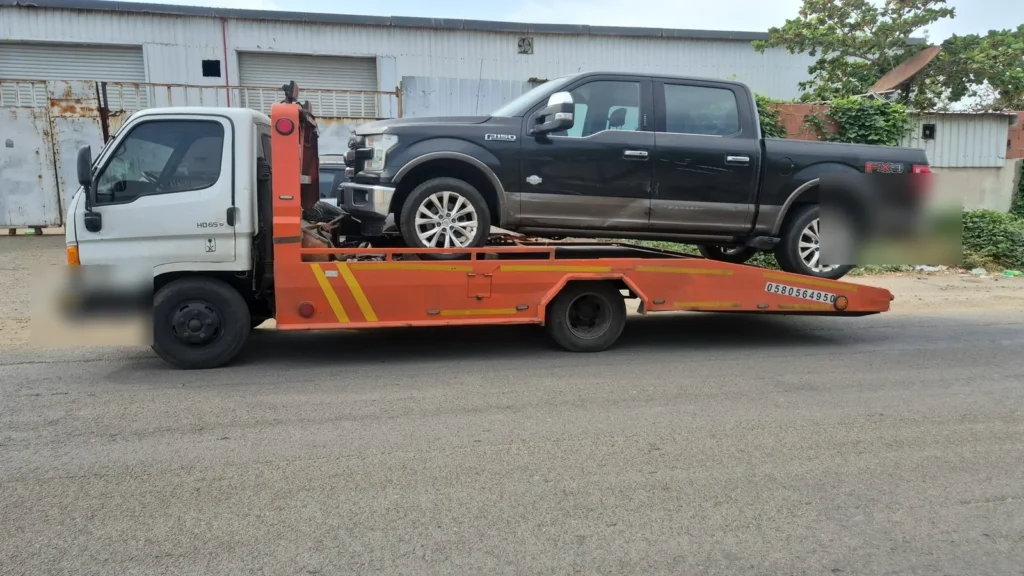
This article explains why most manufacturers recommend transporting EVs and hybrids on a flatbed, what transport or tow mode is, what to do if the 12V battery is weak and the car will not respond, why we ask about the model and weight, and where we attach the car. Satha Alam has been moving cars in Jeddah for more than ten years, and our tilting hydraulic flatbed carries the whole car with no wheel touching the road.
Why should an EV not be towed with its wheels on the ground?
For conventional automatic cars, many manufacturers allow towing for a short distance at low speed under specific conditions, although a flatbed is still better. With EVs it is more delicate. The electric motor acts as a generator when the wheels turn, which is the principle behind regenerative braking that charges the battery when you slow down. When a switched-off or faulty EV is towed with its wheels turning, voltage can be generated in components that are not ready for it, or parts of the drive system can overheat.
There is a second reason. Many EVs have an electronic park lock or electric parking brake that locks the wheels when the car is off or when the small battery is flat. Towing a car with locked wheels means friction and damage to the tyres or brakes. And if the car is all-wheel drive with a motor on each axle, lifting one end and towing the other does not solve the problem, because the axle on the ground still has a motor turning.
That is why most manufacturers recommend transporting an EV on a flatbed with all wheels off the ground. Some allow moving it a very short distance at walking pace only, to get it out of a tight spot or onto the bed. The details are in each car’s owner’s manual, which is always the first reference.
Hybrid cars: usually the same rule
Hybrids combine a petrol engine and an electric motor, and many use a special transmission linked to the electric motors. So many manufacturers treat them like EVs for transport: a flatbed is better, and towing with the drive wheels on the ground can harm the hybrid system even if the car looks like any ordinary car from outside.
Plug-in hybrids have a bigger battery and more weight than regular hybrids, so we ask about them specifically. Do not assume your hybrid can be towed like a petrol car, even if someone tells you they towed one before with no problem. Drivetrain damage does not always show up right away.
If you are not sure whether your car is a hybrid, check the badge on the tailgate or sides, ask your dealer, or send us a photo of the registration and model and we will help you find out. It changes how we load the car.
Quick comparison: towing a regular car vs an EV
This table sums up the practical differences we see day to day between conventional cars and EVs during transport. It is a general picture, and every car has its own instructions in the owner’s manual:
The practical takeaway: if your car is electric or hybrid, treat a flatbed as the default and ask whoever comes to carry the whole car. If someone wants to lift one end and drag the other wheels on the road, politely decline.
| Point | Regular petrol car | Electric or hybrid car |
|---|---|---|
| Best transport method | Flatbed preferred, some brands allow limited towing with conditions | Most manufacturers recommend a flatbed with all wheels off the ground |
| Neutral | Mechanical neutral on most cars | Usually an electronic transport mode that needs power to engage |
| 12V battery | If flat, the car can often still roll in neutral | If flat, wheels, doors and screen may stay locked |
| Weight | Average for its size | Usually heavier because of the large battery |
| Tie-down points | Towing eye and known chassis points | Specific points, avoid pressure near the battery underneath |
| All-wheel drive | Lifting one axle possible in some cases | Motor on each axle, so all wheels must be off the ground |
| After an accident | Watch for fuel and fluid leaks | Watch for smoke, heat or smells from the battery area |
Car stuck? Let us pick it up now
Call us or send your location on WhatsApp. We will tell you the price and arrival time in minutes. The Satha Alam team is ready day and night.
Transport or tow mode: what to do before we arrive
Most EVs have a special mode called transport mode, tow mode or stay-in-neutral, which releases the wheel lock and lets the car roll slowly onto the flatbed. It usually needs enough power in the car. These are the steps we normally ask you to take:
If you cannot find how to enable transport mode, or it does not work, do not worry and do not press random buttons. Send us a photo of the screen and the model. In many cases we find a solution once we understand the car’s condition, and we agree the best loading method with you before we move.
1. Open the owner's manual or app
Look for the towing or transport section and check how transport mode is enabled on your exact model.
2. Enable transport mode if you can
On many cars it is done from the screen or the gear selector with the brake pressed, and stays on until you cancel it.
3. Do not lock the car and walk away
Some cars cancel transport mode or lock themselves if the key or phone moves away. Keep the key nearby until loading is done.
4. Send us the model and condition
The make and year, the fault message on screen, the battery level and whether transport mode engaged.
5. Prepare the spot
If the car is in a basement or tight parking, send a photo of the space and ramp so we know the loading angle.
A weak 12V battery: when the car will not respond
Many people are surprised that an EV has a small 12V battery besides the main battery. This small battery powers the locks, screen, computers and system start-up. If it goes flat, the main battery can be full and the car still will not start, open its doors or enter transport mode.
In that case, do not jump-start the car from another vehicle unless the owner’s manual explains and allows it, because the connection points on some EVs are hidden or have special instructions. Contact the dealer or the brand’s customer service first. If you cannot enable transport mode and the wheels are locked, we tell you honestly what is possible before we move and decide the best approach with you based on where the car is.
Jeddah’s heat can wear small batteries over time, and many EV breakdowns we see are caused by this battery, not the motor or the main battery.
Heavy weight: why we ask about the model before we move
EV batteries are heavy, so an electric car is usually heavier than a petrol car of the same size. A mid-size electric sedan can weigh more than a larger petrol sedan, and large electric SUVs and pickups weigh much more.
Our hydraulic flatbed suits light-to-medium loads up to about 3.5 tons. Most EVs and hybrids in Jeddah fall within that, but some very large models can come close or exceed it. That is why we ask for the model and year before moving and confirm the weight. If your car is heavier than suits our flatbed, we tell you honestly from the start rather than discovering it on arrival.
Weight affects more than capacity. It changes how we tie down, the loading angle and winch speed. We handle heavy cars slowly and position them evenly on the bed.
If the boot or cabin is loaded with heavy items, we ask you to empty it if possible. It reduces weight and keeps your belongings from shifting on the way.
Tie-down and loading points: where we hold an EV
The main battery usually stretches across most of an EV’s floor. Any pressure or scraping there can damage the battery casing, so we are very careful when loading and securing. These are the main points we watch:
After loading we check the car once more before setting off: tighten the straps, make sure the car is centred on the bed and that no part of the bumper or wing is near the edge. On the road we drive smoothly and avoid hard braking and fast speed bumps, especially on inner streets with many bumps.
- We use the manufacturer's towing eye where available. Many EVs hide its socket behind a small cover in the bumper.
- We never attach the winch or straps near the battery or to cables and pipes under the car.
- We secure the car by its wheels with straps on four points, which protects the body and the battery.
- We keep the bed angle as low as possible, since many EVs and luxury cars sit low with front bumpers close to the ground.
- We winch slowly if the wheels do not roll freely, and stop at once if we feel unusual resistance.
- We make sure charging is stopped and no cable is connected before we start.
Tesla, Lucid and hybrids: general notes
Every brand has its own instructions, and we cannot sum up each manual in a line. These are general notes from our work with EVs and hybrids in Jeddah, and the owner’s manual remains the reference:
Tesla
Most models have a transport mode on the screen that releases the wheel lock and needs a working 12V battery. Tesla recommends transport with all wheels off the ground.
Lucid
Luxury, relatively heavy and low cars. We ask for the model, take care with the loading angle and tie-down points, and follow its transport mode instructions.
Regular hybrids
Like the hybrid sedans and SUVs common in Jeddah. Many brands prefer flatbed transport because of the hybrid drive system.
Plug-in hybrids
Bigger battery and more weight, so we treat them much like full EVs.
Small EVs
Relatively light and easy to load, but the same rule applies: all wheels off the ground and transport mode before moving.
Electric AWD
A motor on each axle, so lifting one axle will not work. A full flatbed is the answer.
Special cases: accidents, water or battery heat warnings
If an EV has been in a serious accident, driven through deep water during rain, or shows a battery temperature warning, extra caution is needed. If you see smoke, hear crackling or smell something unusual from under the car, move well away and call emergency services first. Transport comes after the situation is safe.
For ordinary accidents we move the EV home, to assessment or to the dealer the same way: all wheels off the ground, tie-downs away from the battery and delivery with photos. If the dealer or insurer has given instructions about where the car goes or how to move it, send them to us before we set off.
We work inside Jeddah and its districts only, whether the car is in the north near Obhur, in the city centre or in the south.
Book a flatbed for your electric car with Satha Alam
If your electric or hybrid car needs moving inside Jeddah, call or WhatsApp us on 058 056 4950, any time day or night, including Fridays and Eid.
Send your live location, the model and year, the fault message and battery level, whether transport mode works, and the destination. We confirm the weight and give you a clear price before we move. Our arrival time depends on your location and traffic, and we give you an honest estimate.
FAQ
Frequently asked questions
Can an electric car be towed with its wheels on the ground?
How much is a tow truck for an electric car in Jeddah?
My EV will not start or unlock. What should I do?
Do you transport hybrid cars on a flatbed?
Can your flatbed carry heavy electric cars?
Do you move Tesla and Lucid cars?
Can you take my EV from Jeddah to Riyadh or Makkah?
What should I send before you move my EV?
About Satha Alam
Satha Alam provides car towing and transport in Jeddah. 10+ years in Saudi Arabia, 19,000+ vehicles towed safely and 94% customer satisfaction. Available for you 24 hours a day.
Our tow truck services in Jeddah
Related articles
Tow truck arrival time in Jeddah depends on your location, ours, traffic and the time of day. An honest look at what decides it, approximate ranges by area, and simple ways to shorten the wait safely.
Had an accident in Jeddah and your car cannot move? This guide sets out the general steps after a crash, what documents to keep, and how we move a damaged car to assessment or a workshop with a winch and hydraulic flatbed, even when its wheels do not turn.
Looking for a cheap tow truck in Jeddah? An honest guide to saving on towing safely, spotting cheap offers that end up costing more, plus a checklist to use before you agree to any tow truck.
Car stuck? Let us pick it up now
Call us or send your location on WhatsApp. We will tell you the price and arrival time in minutes. The Satha Alam team is ready day and night.